
Campus hiring
How to run a campus hiring drive online
A practical sequence for graduate recruitment: branded applications, skills assessments, integrity review, and interviews that stay connected to one role.

Campus hiring fails in the hand-offs. Applications sit in a form tool, tests live in another tab, and interviewers receive a spreadsheet with names and little else. By the time a placement cell asks for a shortlist, the team is reconstructing context instead of reviewing it.
An online campus drive works when every graduate for a role follows the same path, and when the evidence from each step is still attached to that person when a recruiter opens the file.
What a campus drive actually has to do
A typical India or APAC graduate programme is not a single test. It is a public apply step, an eligibility filter, one or more timed assessments, a human shortlist, and interviews packed into a few campus days or a remote week.
The operational risks are predictable:
- Volume arrives in a burst, not a trickle.
- Many candidates have similar CGPAs and project lists.
- Coding, aptitude, and communication need different instruments.
- Integrity questions appear as soon as the test leaves a college lab.
- Interviewers need scores and responses, not only a rank.
Resumes still matter for eligibility and background. They are a weak ranking signal when thousands of final-year students apply to the same graduate software role.
Design the drive as stages, not as one long form
Start from the decision you need, then work backwards.
- Apply. Collect the fields you will actually use: name, email, campus, department, resume, and any knockout questions. Extra fields slow completion and rarely get read.
- Screen for the work. Use a timed assessment whose formats match the job: multiple-choice for fundamentals, coding for engineering roles, written answers where communication is part of the work, file submissions for design or analysis tasks.
- Review with evidence. Shortlist from scores plus the responses and integrity flags, not from rank alone.
- Interview with context. Schedule Google Meet or Microsoft Teams from the same candidate record so the interviewer sees how the person got there.
Keep progression rules explicit. A campus drive that “feels” sequential but is actually a pile of links will leak candidates and duplicate work.
How Edgeryt Hire runs this path
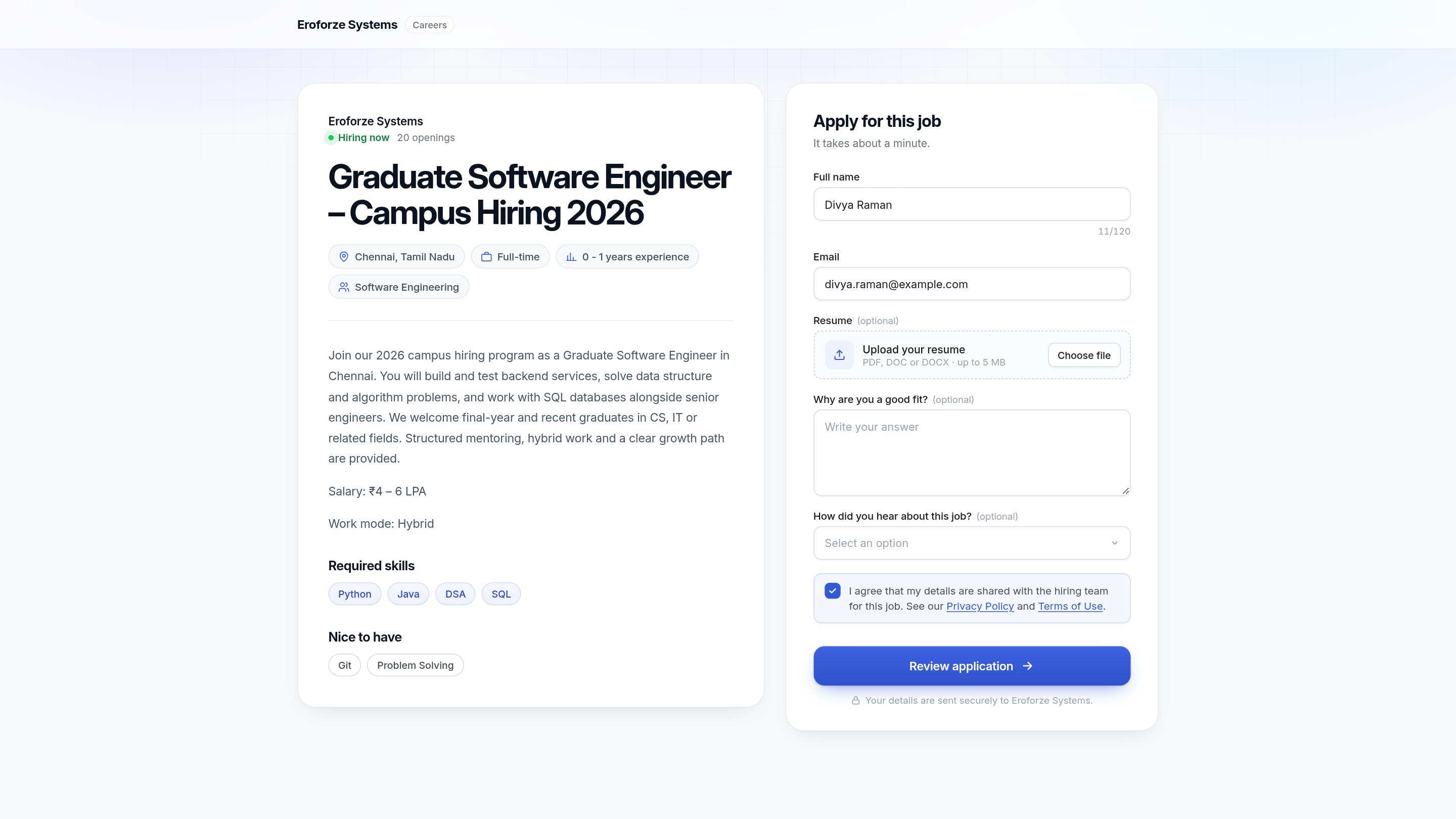
Edgeryt Hire is hiring and skills assessment software for recruitment teams. For a campus drive it connects:
- Branded application pages for the role
- Multi-format assessments (multiple-choice, coding, written responses, file submissions)
- Your own questions or a question library
- Proctoring configuration and integrity review
- Stage progression and shortlisting
- Interview scheduling through Google Meet and Microsoft Teams
Recruiters and interviewers see candidate information, assessment scores, and stage movement on the same role. Scores and flags are context for a human decision; they are not a substitute for one.
Campus placement teams who need student rosters, faculty banks, and institutional drives should look at Edgeryt Campus, which is a separate product. Hire is for the employer side of the same season.
Related reading: skills assessment versus resume screening, multi-stage technical assessments, and shortlisting at volume.
A working sequence for the next graduate cohort
- Publish one apply page per role, even if several roles share a test.
- Import or build the question set before the apply link goes to TPOs.
- Decide which sections are knockout versus diagnostic.
- Configure monitoring to match the risk of the test (a short MCQ and a take-home project do not need the same controls).
- Brief interviewers on how to read the report: score, selected responses, integrity flags.
- Keep a named owner for exceptions (late joiners, accessibility, campus lab outages).
Questions teams ask
Do we still need a resume if we run a skills test?
Yes, for identity, eligibility, and later paperwork. Use it as an input, not as the ranking engine, when the cohort is large and similar on paper.
Can one assessment cover aptitude and coding?
Yes, if you split them into sections with their own timing and scoring. Mixing both into an untimed blob makes it hard to say what a score means.
Should every campus test be proctored?
Match monitoring to the decision. High-stakes, timed, remote tests usually need a configured policy and a review step. Integrity flags prompt that review; your team still decides.
Next step
See the product overview for features and device notes, compare plans, or request a demo for a graduate hiring workflow.