
Shortlisting
Skills assessment vs resume screening: when each one is the right filter
Resumes are useful for eligibility. Skills assessments are useful when many applicants look the same on paper. Use both, in that order.

Resume screening is fast and familiar. It is also where campus hiring quietly becomes a CGPA and keyword contest. Skills assessment is slower to set up and clearer at the point of decision — if the test measures the job.
The useful question is not “which tool wins.” It is which filter belongs first for this role and this volume.
What a resume can honestly tell you
A CV is good at:
- Eligibility (degree, location, notice period, work authorisation)
- Trajectory (internships, relevant domains)
- Communication of a career story
- Signals you will verify later (employers, dates)
It is weak at ranking 2,000 similar final-year students. Shared templates, similar projects, and inflated skill lists compress the distribution. Human screeners then over-fit to college brand or formatting.
What a skills assessment can honestly tell you
A well-designed test is good at:
- Whether the person can complete a task like the work
- Relative performance in a cohort under the same rules
- Work samples you can show an interviewer
It is weak at motivation, collaboration, and anything the format does not include. A perfect MCQ score is not a staff-engineer signal. A missed edge case in a timed coding problem is not a character judgement.
Use assessment formats that match the job: multiple-choice, coding, written responses, file submissions. If the job is writing SQL, do not rank on puzzles that never mention tables.
A combined filter that hiring teams can defend
- Resume / application fields for knockouts you are willing to stand behind.
- Skills assessment for the remaining pool.
- Human review of responses, not only of rank.
- Interview for the traits the test did not measure.
Edgeryt Hire keeps the application, the scores, and the stage on one candidate record so that step 3 is possible. Recruiters still make the hiring decision.
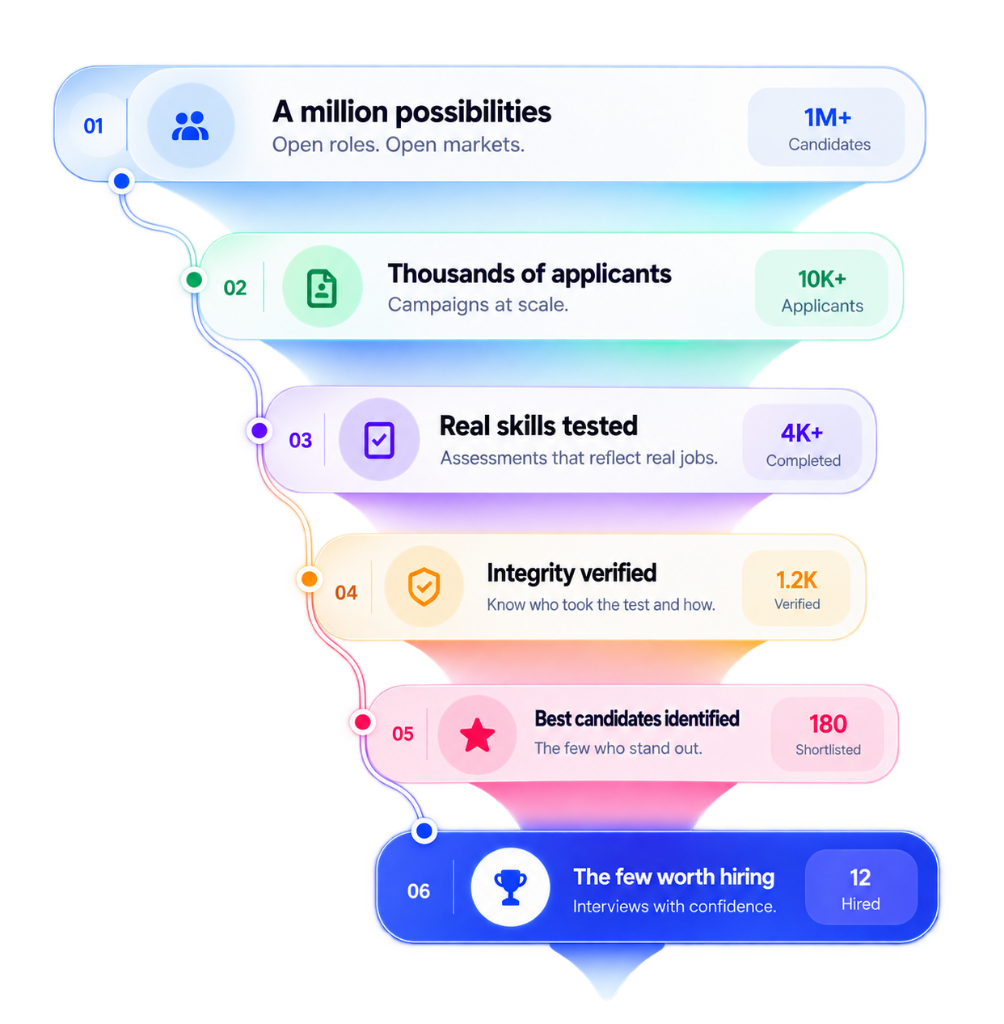
How Edgeryt Hire supports this split
Create a branded apply page, attach an assessment, and shortlist from scores plus responses. You can import existing questions or use the library. Integrity flags sit beside the attempt so a surprising score has context.
Employers running this against college talent are still on Hire. Colleges measuring their students’ readiness before companies arrive are on Campus.
Related: shortlisting at volume and campus hiring drives.
Common mistakes
- Testing trivia that senior engineers on the panel could not pass without Google.
- Using the same cut-off for intern and lateral roles.
- Reading only the leaderboard and never opening an answer.
- Calling the process “AI hiring” when a model only ranked resumes. If you score written answers with a model, keep a human review.
Questions teams ask
Is a skills test biased?
Any instrument can be. Bias control is in the job analysis, the sample, the time allowed, and who reviews exceptions — not in skipping measurement.
Can we skip resumes entirely?
You still need identity and contact fields. You can delay the PDF until a later stage if the file is not used in the first screen.
Does Hire rank resumes automatically?
Hire connects applications and assessments so people can review them. Hiring decisions stay with the team.